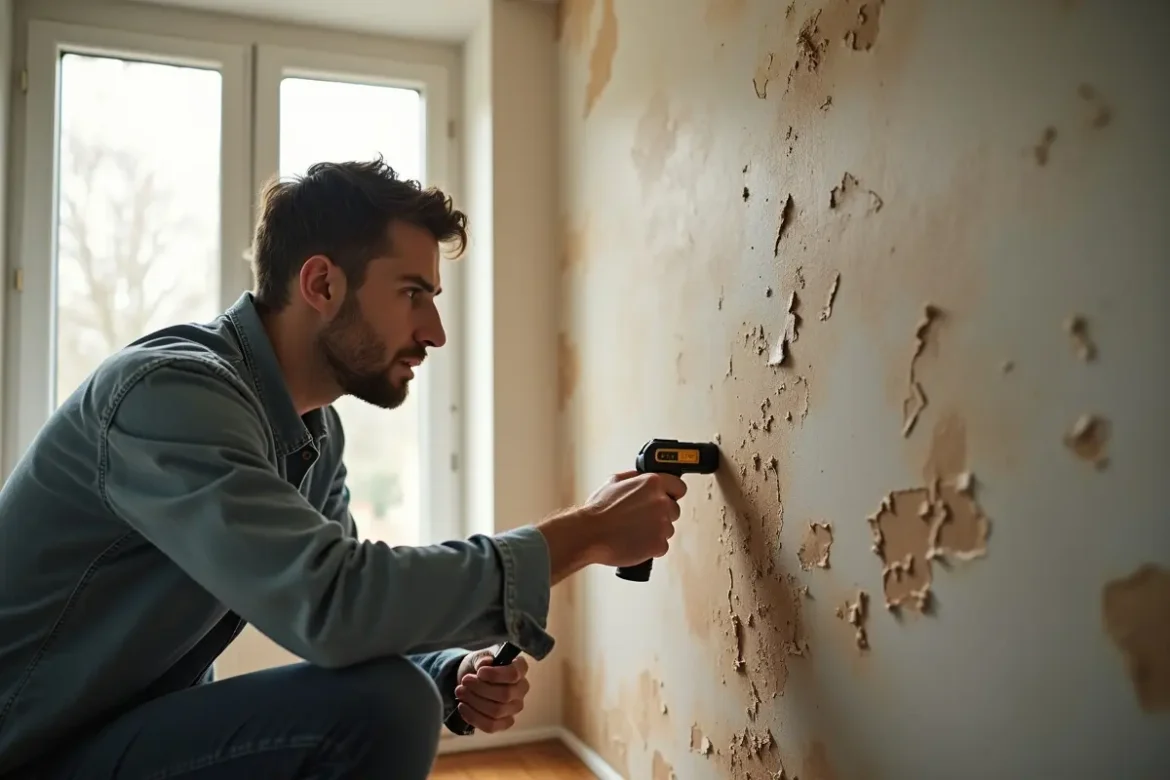
Typically, water damage does not make itself known through flooding. It rather happens silently – behind drywall, under flooring, or within concrete – and becomes apparent only when the damage is extensive and costly to repair. Being able to identify early warning signs can help in addressing the issue early on and prevent further damage.
Contents
The deceptive surface problem
Drywall is a good liar. While the side of it facing the room can seem completely dry, the other side in the wall cavity can be a different story, with mold flourishing, and the wooden studs used for framing becoming saturated and rotting. All because water can get through.
The water gets in, it soaks through the drywall’s gypsum, and then it evaporates through the drywall’s room-side surface. But not before saturating the paper on the back, and rotting any wood studs in the way. Plaster also behaves like this. A quick feel tells you the wall is dry – but it isn’t, three inches in! If a wall feels cooler than it should be, given the exterior conditions or HVAC vent, a moist wall may be why.
What your floors are telling you
Floors actually show signs of moisture before most anything else, though they’re the easiest sign to miss if you don’t know what you’re looking at.
Solid hardwood planks will “cup” – the edges of each board will rise slightly higher than the center, creating a subtle wavy pattern across the floor – because the subflooring between the wood and the space below is warping from moisture. By the time plank wood cupping is visible to the naked eye, the plywood of your subfloor might already be warped or rotting and sucking up gallons of water like blotting paper. Vinyl tile feels slightly spongy underfoot, like you’re stepping on a mattress? Then the moisture in the subfloor layer has probably unglued the adhesive bond. If a floor flexes slightly where it used to feel solid, it’s time to scare up a drywall saw.
The smell that doesn’t go away
A persistent musty smell is not a cleaning problem; it’s a cause for major concern. This smell results from chemicals released as mold and bacteria metabolize organic materials in a dark, damp area. These volatile compounds, typically called “mVOCs,” are very good at diffusing through walls, flooring, and insulation, often long before enough mVOC-producing mold is visible to provide a clue.
Putting air fresheners or burning candles to mask the odor only delays the inevitable. If the smell returns within a day or two of giving the room a good airing, something is growing in your house. In homes, particularly vulnerable spots are wall cavities behind sinks, the underside of subfloor near bathroom fixtures, and the spaces around a plumbing manifold – sometimes the source of a slow leak.
Mold spores can germinate in 24 to 48 hours; the smell therefore means the conditions in the room have been supporting mold growth for at least that long. That’s why a professional service specializing in Water Damage Restoration Fort Worth TX can be worth calling before things get worse.
Foundation and basement signals
Efflorescence is that white, powdery deposit left behind when water evaporates from a concrete surface. It’s not harmful in itself, but it does indicate the ongoing movement of water through that concrete. If you see it in your basement, a garage floor, a warehouse floor, a tunnel, or some other structure’s concrete wall or slab, you can be pretty sure that you also have a seepage problem.
The water can only enter if there are openings in the concrete. Cracks are such openings, as are tiny capillaries and honeycombs sometimes left behind as the concrete cures. As freeze-thaw cycles cause these openings to expand, more water can enter. (For this reason, efflorescence can be a harbinger not only of leaks, but of more leaks to come.)
The water meter audit
Step one, shut off every water-using appliance in your house. No dishwasher, no ice maker, no irrigation system. Step two, find your water meter, take a reading, then don’t touch any water for two hours and reread the meter. If the numbers changed, water is flowing through your pipes when it shouldn’t be. The number doesn’t have to change by much; any difference points to a hidden leak. This check is free and takes an afternoon, but it turns your attention to a problem instead of guesswork.
Relative humidity is another number you want to keep an eye on. Any time it’s above 60%, you’re giving mold and wood decay everything they need to grow faster. A cheap little digital hygrometer can tell you if your house’s moisture content is in a safe range.
When visual checks aren’t enough
A flashlight and palm pressed to drywall only reveal so much. A professional inspector uses moisture meters that measure actual moisture content inside walls, and infrared thermography – thermal imaging cameras – to detect hidden moisture pockets based on temperature differentials invisible to the naked eye. These tools routinely find active water damage that a homeowner would walk past without suspecting anything.
If your meter test shows unexplained consumption, if floors are cupping, or if a musty smell won’t clear, don’t wait for something to become visible. Get a professional out to locate the moisture source and extract it before mold establishes itself and structural rot begins.
Water damage affecting approximately 1 in 50 insured homes annually (American Insurance Association) isn’t all from burst pipes and floods. A significant share starts exactly the way this article describes – quietly, slowly, and long before anyone realizes there’s a problem.
The homes that avoid serious damage aren’t the lucky ones. They’re the ones where someone was paying attention to the right things.